Shipping Wenlan, a simple, local-first llm-wiki
- Authors
 Lucian
- Date
- Updated Sep 14, 2026
- 5 min read
TLDR: Wenlan is live: a simple, local-first llm-wiki. It started with a project called origin, went through the memory-tool dead end, turned at Karpathy's llm-wiki post, and became a wiki that maintains itself, for me and my AI.
Wenlan is live: a simple, local-first llm-wiki. A wiki that maintains itself, for me and my AI. It is what I have spent the last five months building, open source at github.com/7xuanlu/wenlan.
But Wenlan did not start from a blank page. It started with another project, called origin.
Conversations rot
I talk to AI every day, and those conversations produce a lot of useful stuff: decisions, conclusions, mistakes I do not want to repeat. But it all sits scattered across chat threads. I cannot find it again, and I cannot carry it into the next session. Given enough time it rots, as if it never happened.
My thinking back then was simple: memory should be human-centered. Not tied to a platform. Mine. So I started sketching a local-first personal memory tool.
The memory road goes nowhere
As I built, I surveyed the memory projects out there: claude-mem, agentmemory, basicmemory, openmemory. Plenty of people working on it. But the more I looked, the clearer it became that adoption and any commercial path both look bleak.
A few reasons. First, the unit of memory is too small. Nobody is going to open up a single memory unit and read it. Second, what people actually want is simple: they want the agent to remember them. Platform-native memory from ChatGPT, Gemini, and Claude is already good, already free, and only getting better. Third, not that many users need one human-centered memory spanning every model and platform.
My call: these projects will get iterated away and end up as training material under the big models.
Karpathy's post
The turn came from an X post by Andrej Karpathy about llm-wiki. He showed how a personal research wiki compounds: lint, schema, maintenance flows that make notes worth more the longer you keep them.
I found it fascinating. Put memory together and write it up as articles: more context for agents, something humans can actually read, never stale, never contradicting itself. That looked like the answer.
The Cambrian explosion, then the verdict
Not long after, projects sprang up everywhere: llm-wiki, swarmvault, obsidian-claude, several with GUIs. The knowledge-base corner got hot, and for a moment I felt behind again.
But after going through these projects one by one, I reached the opposite conclusion. They hand you Karpathy's whole apparatus and make you its operator: you co-evolve the schema file, you curate the raw sources folder, you run lint, you work through the review queue. nashsu's llm-wiki, the most popular implementation, states the deal plainly in its README: human curates, LLM maintains. These are research instruments, and the human is part of the instrument.
That is not what I want. I want an AI-native app, as simple as possible. And one non-negotiable: it must not end with me maintaining it.
So what Wenlan is
Wenlan is a living wiki. For me, and for my AI.
This may sound like another memory tool. The difference is the unit: memory tools store fragments no human will ever open and read. Wenlan distills them into pages a human can actually read. The page is the product, not the index.
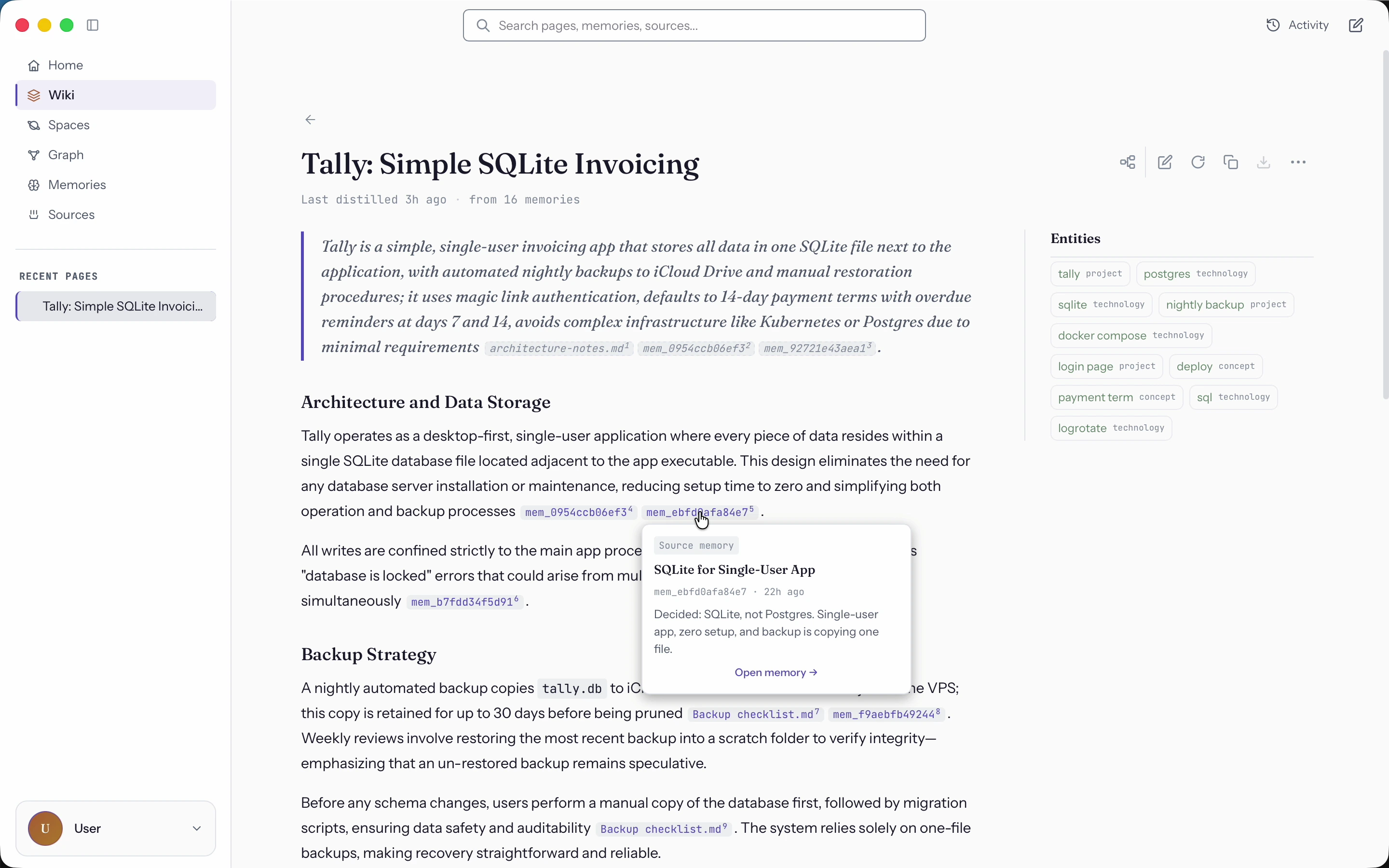
A distilled wiki page: hovering a citation reveals the source memory. Recorded in the app with demo data.
During a session, /capture saves the useful decisions. Between sessions, /distill builds them into sourced pages. Next session, /brief finds them again. It runs as a local daemon, inside the desktop app or headless. Claude Code, Cursor, and Codex connect over MCP. An Obsidian vault can be attached read-only, so the originals stay untouched while Wenlan keeps its own wiki alongside.
Pages are Markdown, grep-able, portable. Every claim links back to its source. When sources change, the pages follow. Pages I wrote by hand need my approval before the AI touches them. Nothing to maintain, because the maintenance is the product.
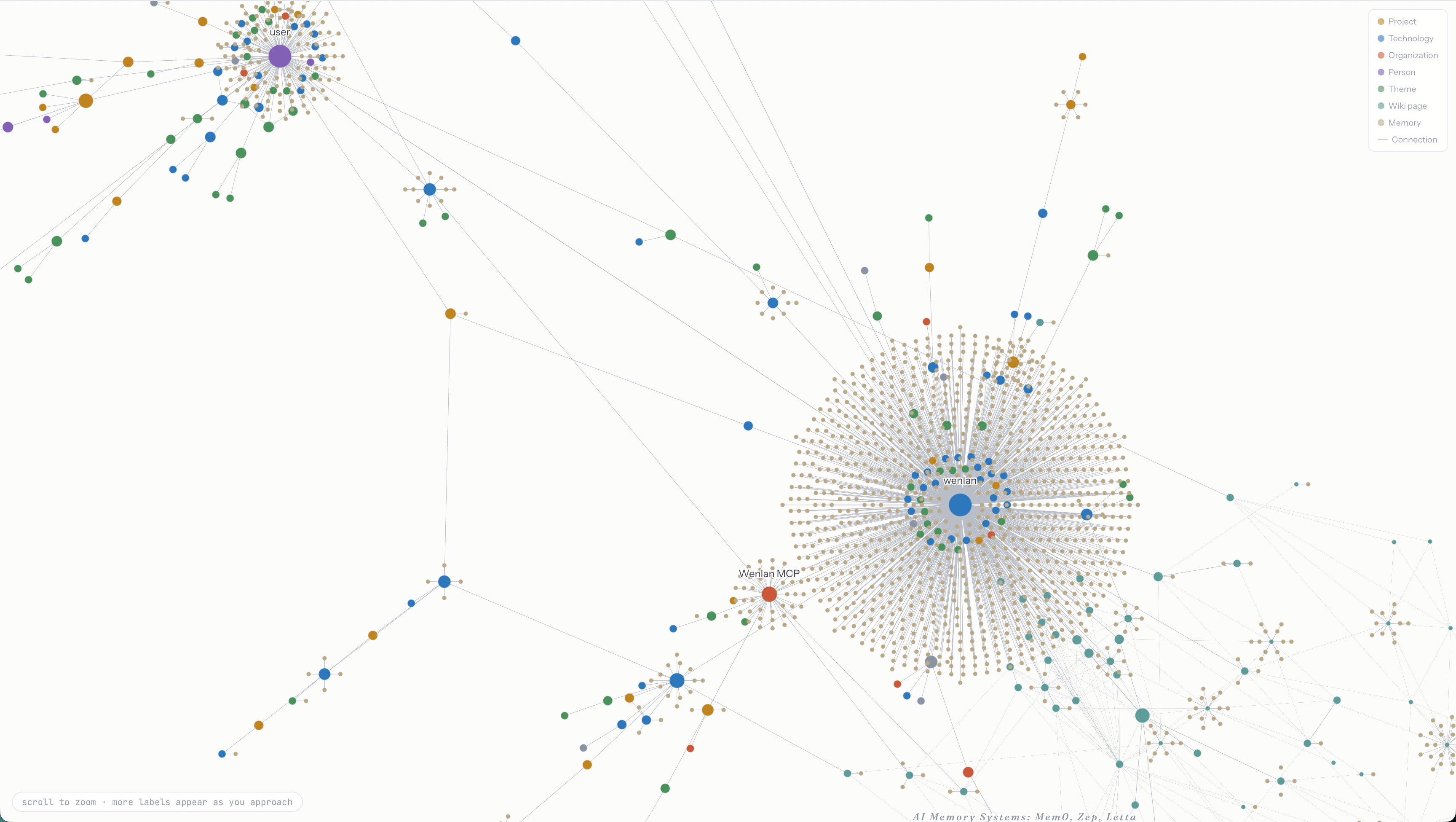
My own Wenlan's knowledge graph: connected records, entities, and wiki pages. Real data, September 2026.
Who it is for, and who it is not for
Wenlan is for people who live inside AI chat. If your decisions and conclusions rot in chat threads the way mine did, and you want them back as pages you can read and your agents can use, that is who I built it for. It is also for Obsidian users who want AI leverage over their notes without letting anything rewrite the vault.
It is not for everyone. If ChatGPT or Claude's built-in memory already covers you, keep using it. It is free, it is getting better, and I said so above. If you enjoy hand-curating a research wiki, Karpathy's pattern and its implementations will serve you better than Wenlan will. Wenlan is for people who want the wiki without the curating.
Where to start
Wenlan is open source and runs locally. v0.18.7 is out today: a desktop app for Windows and macOS Apple silicon, plus headless runtimes for all three platforms. wenlan.app shows real screenshots from my own wiki, so you can see what a distilled page looks like before installing. wenlan.app/learn has the setup guide: install the runtime, connect Claude Code, Codex, or Cursor, and prove the capture-distill-refresh loop on one project before expanding. If you keep an Obsidian vault, there is a migration guide that registers it as a read-only source, so there is nothing to risk.
Wenlan
The name breaks down like this. 文 means knowledge. 瀾 means waves rippling forward, one after another.
What I want is a genuinely useful, simple llm-wiki. Real value. Knowledge that actually iterates. Like the name says: wave after wave, forward.